Mini Mops House Cleaning

Family Owned and Operated Service You can Trust since 1975

Contact Us:

(559) 264-6677
estimates@minimopsinc.com

  • Mini Mops House Cleaning
  • Services
  • What To Expect
  • What Clients Say About Us
  • Policies
  • Articles
  • Contact Us

WARNING: Tenting for Termites Can Leave You Vulnerable

September 18, 2016 By Michele Peterson

House tented for termite treatment can leave you vulnerableThieves who commit residential burglaries generally are looking for the “easy” hit … the house with no security system, windows left open, nobody home. A home tented for termite treatment is all those things … with a big colorful “sign” advertising that fact.

Typically, a home will be tented one day, fumigated the next, then left vacant another 1-2 days while the poison works. Homeowners are instructed to leave alarms off and sometimes windows open.

Hazard signs are posted, and nobody is supposed to enter. But that doesn’t mean they won’t. We’ve heard multiple stories recently of tented homes being broken into.

So protect yourself. Remove your valuables. Ask neighbors to keep an eye out and report any activity. Do random drive-by checks yourself. You can even consider hiring security.

Ask your pest control company for further recommendations and verify what they do to protect your home. And if a sub-contractor does the tenting, be sure to check them out, too.

Filed Under: Household Safety Tips Tagged With: termite tent, treating for termites

Protect Your Home, Keep Your Family Safe From Fire!

October 10, 2014 By Michele Peterson

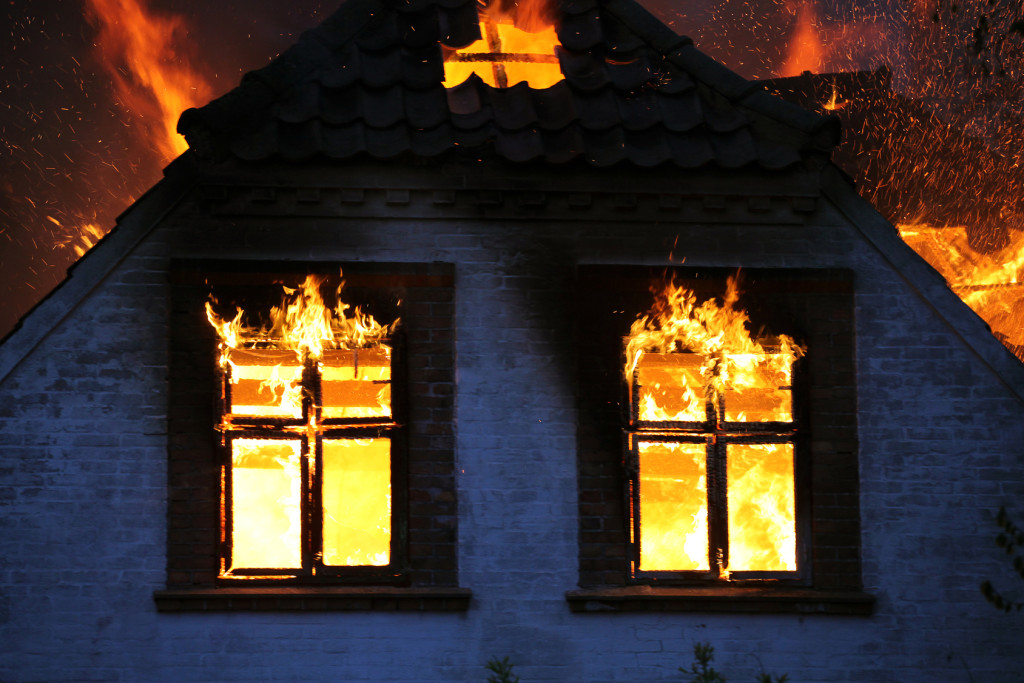
House on fire to illustrate Mini Mops House Cleaning blog post on fire safety

Fire kills 4,000 and injures 20,000 Americans each year, and U.S. fire departments respond to 1.5 million home fires each year … according to the U.S. Fire Administration.

We don’t want you to be one of these statistics!

You should have working smoke alarms in each bedroom and on each floor of your home to alert your family if a fire should occur. But here are some steps you can take to protect your home and prevent a fire from starting in the first place …

Home Fire Safety Checklist:

 Check electrical appliances for loose or frayed cords. Do not place wires under rugs.
 Check for outlets overloaded with plugs; including TVs, game consoles, computers, and printers.
 Install GFCI (ground fault circuit interrupter) outlets in your home; especially near water in your bathroom, kitchen and laundry room.
 Check that the bulbs in your home light fixtures are the correct wattage.
 If any appliances spark, smell unusual, or overheat, replace them or get them repaired by a professional.
 Check that lamps and nightlights are not touching any fabrics (bedspreads, drapes).
 Be sure that electrical blankets are unplugged when not in use. Check for frayed or loose cords and any odd smell. If you detect a problem, replace the blanket immediately.
 Supervise children around the stove and microwave.
 Candles should be out of reach of children and pets, and away from curtains and furniture. Never leave candles unattended.
 Get an annual inspection of your furnace or heating system.

(This checklist is from the National Safety Council. View, download, and print the complete document at http://www.nsc.org/safety_home/HomeandRecreationalSafety/Documents/HomeFireSafetyChecklist.pdf)

Filed Under: Household Safety Tips Tagged With: checklist, fire safety

Follow These 4 Important Rules for Pool Safety

July 16, 2014 By Michele Peterson

Most Valley residents spend time poolside during our hot summers. But as fun and refreshing as they can be, pools also pose a safety risk to your family and friends.

Sandals by a pool to illustrate pool safety rules by Mini Mops House Cleaning

To keep them safe, the American Red Cross suggests these four important pool safety rules :

1. No Diving
2. Stay Away From Drain Covers
3. Swim With a Buddy
4. Walk Please

The Red Cross also suggests assigning a “lifeguard” to be responsible for watching swimmers, especially kids. And be sure to always keep young children within arm’s reach.

These and other pool safety tips can be found on the Red Cross website at http://www.redcross.org/prepare/disaster/water-safety/home-pool-safety.

Your turn … Do you have another pool safety rule that you enforce at your home? Please tell us what it is in a comment below.

Mini Mops, Inc. is a professional house cleaning company serving residential and commercial clients in the Fresno-Clovis CA area since 1975. We are currently accepting new clients. Please call (559) 264-6677 for more information.

Filed Under: Household Safety Tips Tagged With: American Red Cross, pool safety

Bathroom Exhaust Fan Lint is a FIRE HAZARD!

October 24, 2013 By Michele Peterson

You’re probably aware that the lint that builds up in a dryer vent is a potential fire hazard. But what about the lint that accumulates in your bathroom exhaust fan?

Just like dryer lint, bathroom fan lint is flammable, making it a fire hazard.

Before-After Bathroom Vent Cover

Bathroom exhaust fans — generally installed in the ceiling, and made with or without lights — are designed to remove moist air from the room. They help prevent steamed up mirrors, damp walls, and fogged windows, as well as remove odors.

BUT … the moist air combines with air particulates, and lint builds up. It builds up on the outer cover and also inside, on and around the motor. Over time, the lint accumulates to the point where heat builds up and can cause the motor to overheat.

Since the lint also acts to insulate the motor, the heat build-up gets accelerated.

Heat + lint = trouble!

Before-After Bathroom Vent Motor - Fire Hazard

The lint is an easy-to-ignite fuel source for fire, which in turn ignites other nearby combustible building materials in the ceiling and attic. And now you have an attic fire.

Travelers Insurance alone has documented multiple millions of dollars of loss due to fires that originated in overhead bathroom exhaust fans.

ACTION STEPS YOU CAN TAKE TO PREVENT THIS:

1. Inspect and clean all bathroom exhaust fans regularly.

2. When cleaning, remove the fan cover to clean and remove lint from around the motor, paying careful attention to all air-flow areas.

3. Wash the fan cover in warm soapy water to remove all lint. If there is any mold growing, add bleach to the cleaning mixture. Make sure the cover is completely dry before putting it back up.

Yes, this adds some time to your cleaning routine … but it’s worth it to decrease your risk of a fire. So please work it into your routine and be safe.

Until next time … Keep it Clean!

Filed Under: House Cleaning Tips, Household Safety Tips, Household Tips Tagged With: bathroom exhaust fan, fire hazard, lint

Privacy Policy
Copyright © 2026 · Mini Mops Inc · (559) 264-6677